
Andes Heritage Expeditions, designing customized trekking experiences for every level of trekker, taking care of every detail from the moment you land to the moment you depart Bolivia.

8 Days
Medium-Low
4-10 Guests
3800 / 5200 / 4100 M
*Snow-capped volcanoes • Ancient burial towers • A salt lake at 3,800m • Flamingos over blood-red lagoons • Geysers at sunrise*
This is not a trek. This is an expedition across Bolivia’s southwestern wonderland—a multi-day journey that connects three of the Andean altiplano’s most iconic landscapes. From the soaring volcanic peaks of Sajama National Park to the infinite white horizon of the Uyuni Salt Flats, and finally into the otherworldly Eduardo Abaroa National Reserve, you’ll witness a staggering diversity of color, culture, and raw natural power.
Acclimatization is essential. Respect for the altitude and the land will reward you beyond measure.
Snow-capped volcanoes, steaming geysers, and the tallest peak in Bolivia
Our journey begins west of La Paz, crossing high-altitude plains toward Sajama National Park, home to Nevado Sajama—Bolivia’s highest mountain at 6,542 meters (21,463 feet). But Sajama is not alone. The skyline is shared by its volcanic siblings: Parinacota and Pomerape, their perfect cones dusted in eternal snow.
On the way to Sajama we visit the Chullpares—ancient above-ground burial towers built by pre-Columbian cultures. Though empty now, these stone sentinels still whisper of rituals and reverence from centuries past.
Inside the park, we embark on a full-day trek to pristine high-altitude lakes, their surfaces mirroring the volcanoes above. The air is thin, the silence profound. Along the way, we visit a geyser field, where steam hisses from the earth, and then reward ourselves in nearby hot springs—soaking under a vast sky while snow-capped peaks keep watch.
After an early departure, we head toward the small town of Curahuara de Carangas, where a colonial-era church and local cultural site offer a window into Andean life. Then, we drive toward Salinas de Garci Mendoza and the tiny village of Alcaya.
Here, hidden from most tourist routes, lies an archaeological site where ancient mummies remain preserved—silent witnesses to the people who lived and died on this harsh, beautiful plain.
From one salt lake to another, then up a volcano for the ultimate view
From the village of Tahua, we begin our ascent of Tunupa Volcano (5,300 m / 17,388 ft). This is a demanding but deeply rewarding hike. From the summit, the Uyuni Salt Flats sprawl below like a shattered mirror—a dazzling white lake stretching farther than the eye can see, while the smaller Coipasa Salt Lake glimmers to the northwest.
You are standing above the world’s largest salt desert. Take your time. Breathe. Photograph.
We drive onto the salt flats themselves. The crust crackles under our 4×4 tires. There is no horizon—only sky and white.
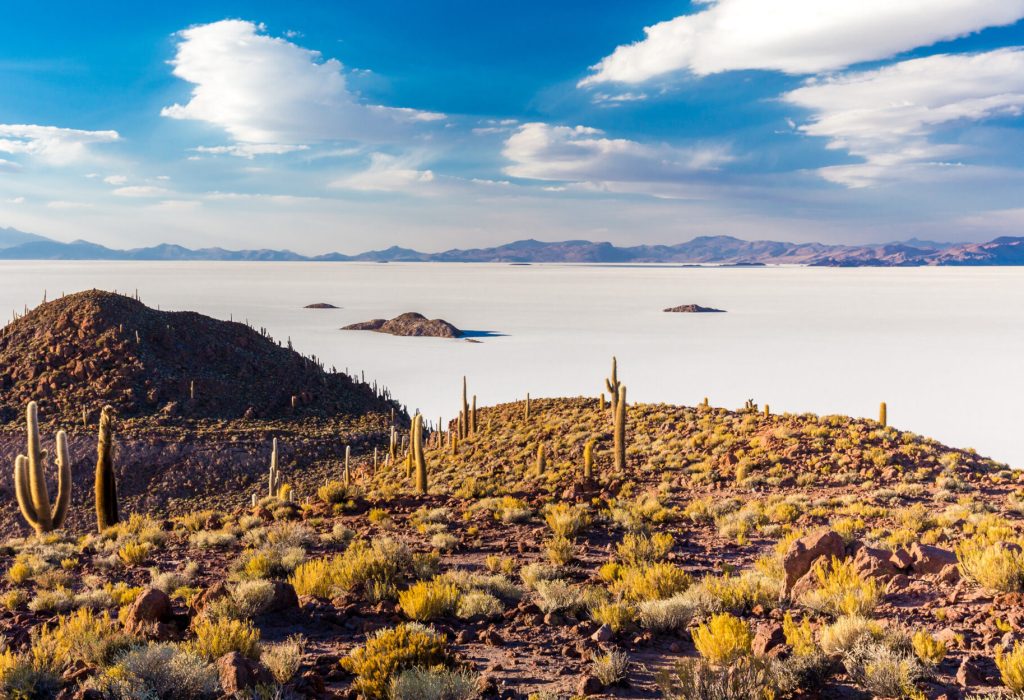
Our destination: Incahuasi Island, a rocky outcrop rising from the center of the salt lake, covered in giant cacti some over a thousand years old. Here, we stay overnight—a rare and magical experience. As the sun sets, the salt transforms into a canvas of pink, orange, and violet. After dinner, we walk the island’s trails under a blanket of stars, with no light pollution for hundreds of miles.
Red lagoons, smoking earth, and flamingos against the desert
From Uyuni town, we enter the Eduardo Abaroa National Reserve—a high-desert wonderland of mineral lakes, geothermal fields, and rock sculptures.
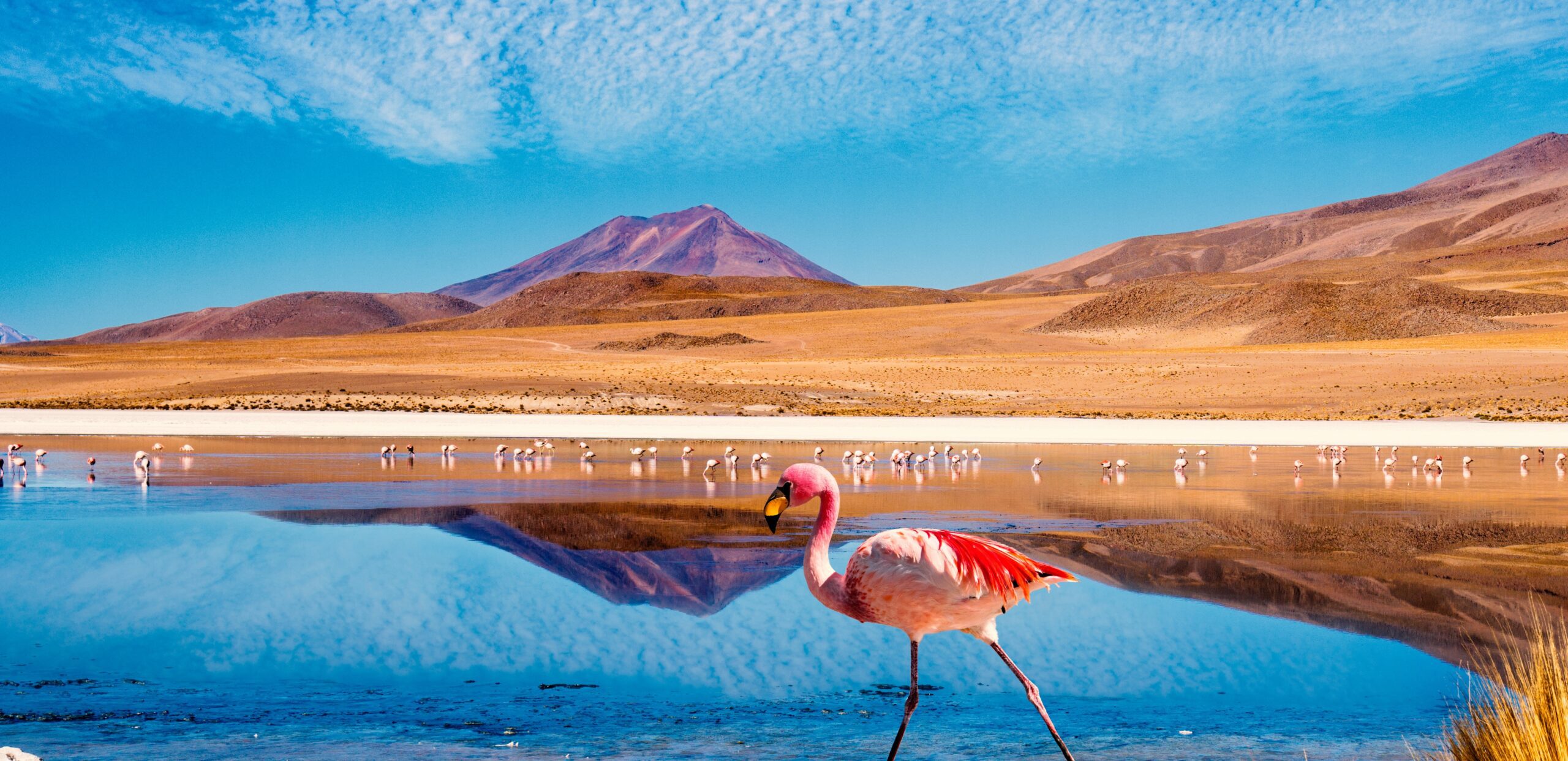
Shallow, saline, and alive with color. These twin lagoons shimmer in shades of pink and soft green, thanks to mineral-rich waters and specialized algae. Their true magic? Flamingos—Andean and James’s species—wading in elegant colonies against a backdrop of volcanic peaks and rust-red desert.
Best time: October–March (breeding season, milder weather). Bring binoculars and warm layers.
A vast, wind-scoured plain of sand, salt, and volcanic soil. This is the Bolivia of dreams—empty, raw, and beautiful. Rising from the desert floor is the Stone Tree (Árbol de Piedra) , an iconic wind-eroded rock formation shaped over millennia. At golden hour, its silhouette against the sky is unforgettable.
Tip: Windproof jacket, sunscreen, and plenty of water. Watch your footing on loose ground.
The crown jewel of the reserve. The water burns deep red—a startling color caused by algae and sediments. White borax islands float like icebergs, and hundreds of flamingos create a moving sea of pink against the crimson surface. The surrounding mountains complete a scene of almost violent, haunting beauty.
Best time: October–March for peak flamingo activity. Keep your distance from wildlife. Bring a good camera.
A geothermal field that feels like the edge of the world. Steam vents roar, mud pools bubble, and yellow/orange mineral terraces glow against the grey earth. Early morning visits are best—the steam rises dramatically into the freezing air.
⚠️ Safety: Stay strictly on marked paths. The ground is unstable and extremely hot. Limit time near sulfur vents.
After days of cold, wind, and thin air, nothing feels better than sinking into the warm, mineral-rich waters of Polques. Simple, rustic, and surrounded by sweeping plateau views—it’s the perfect way to soothe tired muscles before heading back to civilization.
Tip: Bring a towel, dry clothes, and basic facilities expectations. The experience, not the luxury, is what matters.
Our expedition concludes in Uyuni Town, where you can:
✈️ Fly back to La Paz (dramatic aerial views of the salt flats)
🚐 Continue overland to other destinations
🥾 Join another AHE trekking circuit in the Quimsa Cruz or Viloco regions
You will spend multiple days above 4,000 m (13,100 ft), with passes exceeding 5,000 m (16,400 ft).
Acclimatize in La Paz or Uyuni for at least 2 days before starting.
Hydrate constantly. Avoid heavy exertion on arrival. Consider altitude medication if advised by your doctor.
Days: Intense sun, strong UV, possible high winds
Nights: Below freezing, even in summer
Layers are essential (thermal base, fleece, windproof/waterproof outer)
Sunscreen, lip balm, sunglasses, and a warm hat – non-negotiable
Follow your AHE guide’s advice and park regulations
Respect wildlife distances (especially flamingos)
Stay on marked paths in geothermal areas
Leave no trace – fragile high-altitude ecosystems recover slowly
| Feature | What You Get |
|---|---|
| 🏔️ Three iconic regions | Sajama + Uyuni + Eduardo Abaroa – no repetition, only variety |
| 🧭 Expert guidance | Local drivers and trekking guides who know the hidden paths |
| 🏕️ Overnight on Incahuasi | Rare access to a night on the salt flats |
| 🪦 Cultural depth | Chullpares, mummies of Alcaya, Curahuara de Carangas – not just landscapes |
| 🚙 Comfortable 4×4 + trekking | The perfect blend of vehicle support and on-foot adventure |
| ✈️ Flexible exit | Fly or drive back from Uyuni |
| Detail | Information |
|---|---|
| Duration | Multi-day (typically 6–8 days depending on pacing) |
| Starting point | La Paz City |
| Max altitude | 5,300 m (Tunupa Volcano summit) |
| Sleeping altitude range | ~3,700 m – 4,300 m |
| Best season | April–October (dry season); Oct–Mar for flamingo activity |
| Physical level | Moderate to challenging (trekking + high altitude) |
Day 1: Transportation from La Paz to Sajama National Park.
*Overnight in Sajama community.
Day 2: Sajama National Park Activities.
Day 3: Sajama community – Curahuara – Chosen community en route to Salinas.
Day 4: Trip to Salinas Town.
Dia-5: Salinas – Tahua – Tunupa Volcano.
Dia-6: Crossing the Salt Flat – Incahuasi Island – Uyuni.
Dia-7: Visit Eduardo Abaroa Natural Reserve.
Dia-8: Visit Eduardo Abaroa Natural Reserve and return to Uyuni town.
NOTE: Contact us to customize your trekking needs based on your dates available to travel to Bolivia and to offer additional trekking circuits that fit your schedule and needs.
Contact us.